


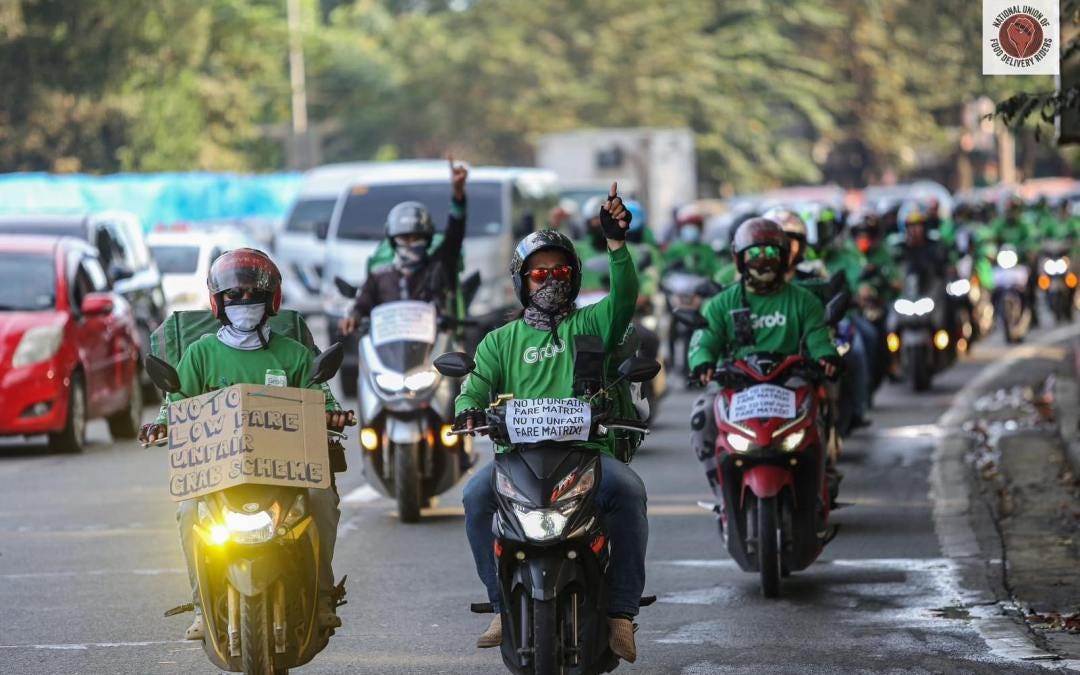
YOU have to hand it to Grab — or rather, Grab will take it from you anyway, daily, whether you like it or not.
The Southeast Asian ride-hailing and food delivery behemoth, which dominates markets from Manila to Singapore, has found a tidy little side hustle: lending money to its own motorcycle riders in the Philippines at interest rates exceeding 230 percent per annum. Labor rights group Center for Trade Union and Human Rights (CTUHR) is calling it exactly what it looks like — predatory.
The arrangement, exposed in a March 3 feature by Nikkei Asia journalist Michael Beltran, works something like this: Grab offers in-app loans to its riders, dangling them as rewards for good performance. Handy, right? The cash comes fast, the terms look manageable, and the daily deductions are automatic. It’s almost too convenient — which, of course, is rather the point.
Take “John,” cited in the Nikkei Asia report. He borrowed P11,000 for bike repairs and tune-up. By the time his 150-day repayment cycle was done, he had paid P14,294 — a deduction of P95.30 every single day. That’s a P3,294 premium on an P11,000 loan. And that’s the smaller loan. For workers who take the full P13,000 option — which, delightfully, is the only qualifying amount for Grab’s monthly raffle — the daily bite is P62.07 for 360 days, totaling P22,343.
“The loans with their interests may be legal and may even be convenient to workers,” said CTUHR executive director Kamz Deligente in a statement. “But it cannot be denied that workers’ incomes are being reduced and Grab, the employer, is earning from this.”
Here’s the twist that makes the whole thing particularly galling: miss a daily payment, and Grab stops sending you bookings. No bookings, no income. No income, no repayment. The workers Grab has loaned money to are, in effect, locked into working — for Grab — to pay back Grab. It is elegant, in a deeply troubling way.
A Fairwork Philippines 2025 report adds weight to the concern, noting that Grab already falls short on ensuring minimum wages, providing protective equipment, and respecting workers’ freedom of association. Platform companies have long hidden behind the “partner” label to dodge employer responsibilities. But a company that isn’t guaranteeing its workers minimum wage while simultaneously profiting from their financial desperation has, critics argue, grabbed far more than it has any right to.
“Ironically, by not ensuring workers’ minimum wages, Grab is earning more from workers’ desire to earn more,” Deligente said.
Grab has defended the loan program, framing it as a benefit. But critics argue that what Grab is really offering isn’t a benefit — it’s a trap wrapped in a rewards program.
The loans may be legal. But legal, as the workers paying them back daily would likely agree, is not the same as right. Grab may be the biggest platform in Southeast Asia. That doesn’t mean it should be in the business of grabbing from the very hands that built it. (Rights Report Philippines)