


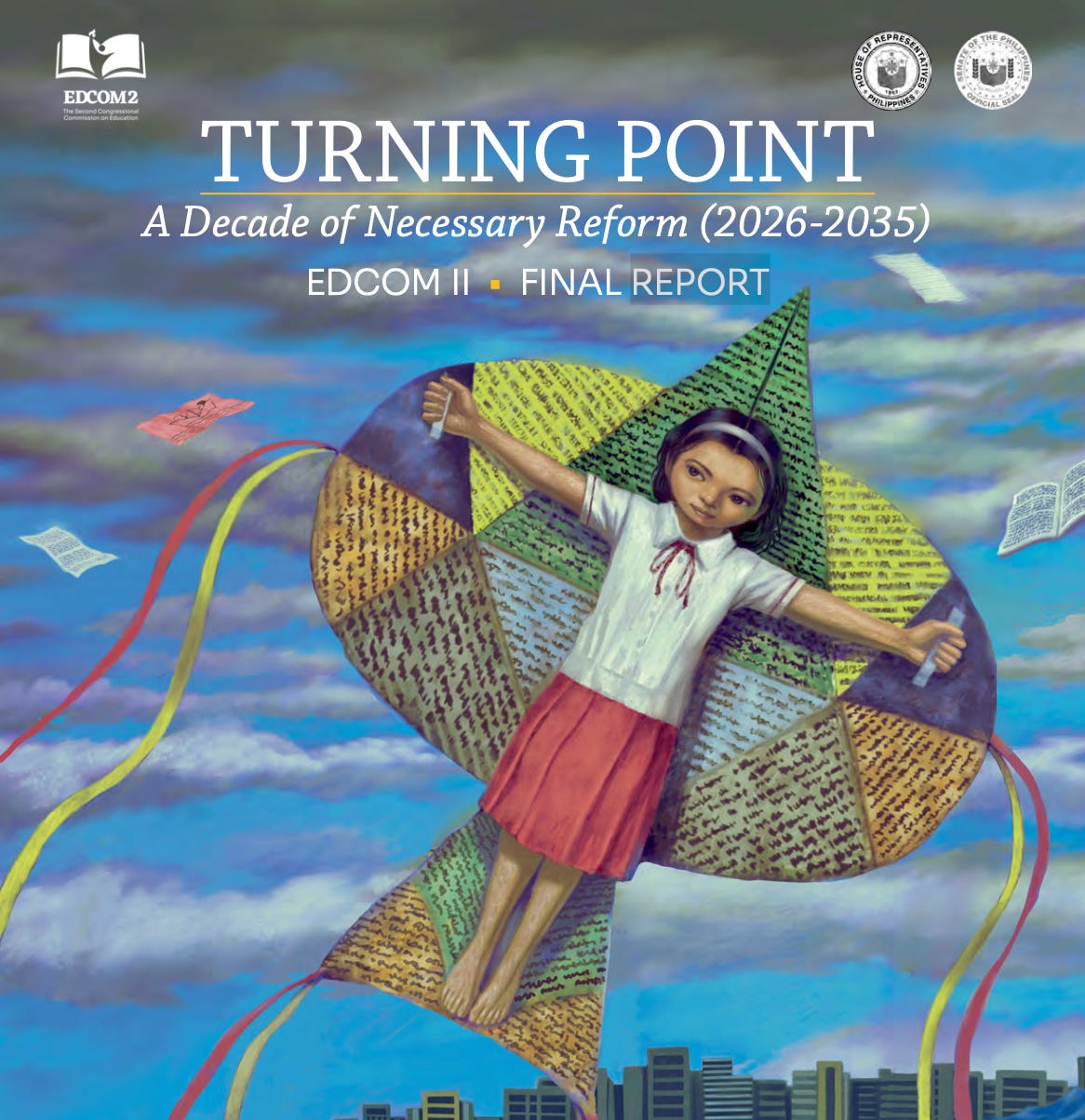
At 634 pages, the EDCOM II Final Report is daunting, to say the least. :-) The irony is not lost on me. It’s as if the hefty report, which details why Filipino schoolchildren are not learning the way they should and why Philippine education is messed up, was designed to NOT be read. But it is an important read.
In any case, since I don’t have the time and the patience to go through it, I fed the report to Google’s NotebookLM. It churned out the text below but also these two video overviews – one in English, another in Filipino – that I think capture the key points of the report. So, keep that in mind: I did not generate these text and videos – NotebookLM did. And I think it did a marvelous job.
The EDCOM II Final Report offers an extensive evaluation of the Philippine education system, highlighting a profound learning crisis fueled by decades of underinvestment and fragmented governance. It presents a strategic roadmap for reform that emphasizes foundational literacy, early childhood nutrition, and teacher quality as the most urgent priorities. The text details critical gaps across all levels, from classroom shortages in basic education to the skills mismatch found in technical and higher education sectors. To address these systemic issues, the report advocates for better interagency coordination, the elimination of “mass promotion” practices, and a stronger alignment between academic training and industry needs. Ultimately, the document serves as a call to action for stable, evidence-based leadership to ensure that educational pathways effectively lead to social mobility and national development.
Fragmented governance across various Philippine government agencies has been identified as a systemic root cause of the current “learning crisis,” leading to disjointed policies, resource inefficiencies, and poor educational outcomes. While the 1994 “trifocalization” of the system into the Department of Education (DepEd), Commission on Higher Education (CHED), and Technical Education and Skills Development Authority (TESDA) was intended to bring order, it instead resulted in a system operating in silos.
The impact of this fragmentation is evident across several key areas:
1. Early Childhood Care and Development (ECCD) and Nutrition Governance for the youngest learners is split across the ECCD Council, DOH, and DSWD for children aged 0–4, while DepEd takes over for ages 5–8. This segmentation has produced:
• Coordination Failures in Nutrition: Stunting remains a serious issue (23.6% of children under five) because nutrition programs are fragmented and poorly targeted. A legal gap leaves children aged 2–3 uncovered by key feeding laws, and DSWD currently reaches only 43% of at-risk two-to-four-year-olds.
• Disconnected Transitions: In many areas, there are no standardized protocols for sharing child records or developmental profiles between ECCD centers and public schools, causing early learning gains to be lost.
• BARMM Vulnerability: In the Bangsamoro region, governance is split across three different ministries (MOH, MSSD, and MBHTE), creating service gaps that contribute to the highest stunting and lowest functional literacy rates in the country.
2. Teacher Preparation and Professionalization A fundamental disconnect exists between teacher training, licensure, and actual classroom needs:
• Licensure Misalignment: Passing rates for the Licensure Examination for Professional Teachers (BLEPT) have been perennially low because the exam (administered by the PRC) is poorly coordinated with CHED curricula and the Teacher Education Council (TEC).
• Specialization Gaps: Because hiring and deployment are handled at the division level without tight links to the training pipeline, 62% of high school teachers end up teaching subjects outside their college major.
3. Articulation Between TVET and Higher Education Overlapping mandates between CHED, TESDA, and the PRC have resulted in “blurred delineation of authorities”.
• Regulatory Redundancy: Institutions may undergo three separate audits (CHED, PRC, and TESDA) for the same curriculum or faculty, leading to operational disruptions and contradictory guidance for students regarding licensure eligibility.
• Pathways and “Ladderization”: Despite the Ladderized Education Act, bridges between the Alternative Learning System (ALS), TVET, and higher education remain “thin”. For example, the absence of standardized Level 5 (Diploma) qualifications undermines TVET’s role as a bridge to higher education.
4. Data Silos and Invisibility The current data landscape fragments the learner’s journey, as DepEd, CHED, and TESDA maintain separate, incompatible systems.
• Learner Tracking: Transitions between subsectors are barely tracked, making it impossible to perform longitudinal analysis of student outcomes, such as employment or persistence in higher education.
• Impact Evaluation: Many mandates of the UniFAST Secretariat (under Republic Act 10687) remain unfulfilled 10 years later, including the evaluation and harmonization of all publicly funded scholarship programs, which hinders efficient resource targeting.
5. Administrative Burden and Accountability
• Interagency Proliferation: DepEd is part of at least 261 interagency bodies, which distracts leadership from its core mandate of basic education.
• Compliance-Focused Targets: Performance targets cascade inconsistently across agencies, often tracking compliance outputs (e.g., reports submitted) rather than actual student learning outcomes, thereby diffusing accountability for the learning crisis.
To address these challenges, the Education and Workforce Development Group (EWDG) was recently established as a central coordinating body to harmonize policy direction across DepEd, CHED, and TESDA. The National Education Plan (NatPlan) also proposes a unified 10-year roadmap to replace this fragmentation with systemic coherence.
The EWDG, established via Administrative Order No. 36 in August 2025, is designed to serve as the central coordinating body to harmonize the Philippine education and training system,. By bringing the heads of DepEd, CHED, and TESDA together under a single cabinet cluster chaired by the President, it aims to replace decades of isolated “siloed” operations with a unified national strategy.
The EWDG will fix fragmentation through the following mechanisms:
1. Unified Policy and Strategic Planning
The EWDG is tasked with ensuring system-wide planning and coordination rather than just acting as a convening body,. It addresses “trunk decisions” that require joint sequencing across agencies, such as:
• Aligning the teacher pipeline and professional development standards.
• Coordinating Senior High School (SHS) tracks with post-secondary pathways to ensure graduates are ready for either college or the workforce,.
• Implementing the National Education Plan (NatPlan), a decadal roadmap that replaces fragmented, short-term projects with sequenced reforms,.
2. Data Interoperability and Unique Identification
To eliminate disconnected data landscapes, the EWDG oversees the harmonization of agency information systems. Under a 2025 agreement, DepEd, CHED, and TESDA will:
• Adopt the Learner Reference Number (LRN) as a unique identifier across all levels of education, transitioning eventually to a PhilSys-enabled system,,.
• Track learner pathways longitudinally, allowing the government to see who progresses, exits, or re-enters the system, which was previously impossible due to incompatible data silos,.
3. Rationalizing Interagency Bodies
The sector currently operates with over 130 overlapping interagency councils and task forces,. The EWDG will:
• Systematically review and eliminate redundant bodies, reallocating personnel to core implementation functions,.
• Establish a permanent secretariat with senior technical experts to ensure institutional memory and technical competence in policy coordination,.
4. Labor Market and Scholarship Alignment
The EWDG will bridge the gap between education outputs and industry needs by:
• Establishing a Unified Labor Market Information System (LMIS) that consolidates fragmented data from the PSA, DOLE, and TESDA,
• Integrating career guidance efforts and scholarship programs into a single platform to improve targeting for disadvantaged students and ensure aid flows toward in-demand skills.
5. Shared Accountability and Aligned Budgets
The Group is intended to move the system toward shared accountability, where performance targets are no longer agency-specific but converge on learning outcomes,. This includes program-convergence budgeting, where agencies like the DOH, DSWD, and DepEd must annually propose funding for early childhood nutrition in a complementary and strategic way.
Recommendations for a Decade of Reform
1. Frontload Investments in the First 1,000 Days: Legislate the expansion of the Supplemental Feeding Program to cover the “missing” two-to-three-year-old gap and integrate nutrition targets into LGU performance scorecards.
2. End “Mass Promotion” Immediately: Rescind the grade transmutation policy and align teacher and principal performance targets (RPMS/OPCR) with actual learning growth rather than just promotion rates.
3. Unburden the Teachers: Fully implement the School Organizational Structure and Staffing Standards (SOSSS) by filling the 12,078 vacant Administrative Officer and 44,285 Project Development Officer positions to free teachers for the classroom.
4. Fix the Teacher Pipeline: Align the Teacher Education Council (TEC), CHED, and PRC to modernize the BLEPT licensure exam and mandate 800 hours of clinical practice (practicum) to match global standards.
5. Build Polytechnic Universities and Ladderized Pathways: Institutionalize the recognition of micro-credentials and create polytechnic institutions that allow TVET diplomas to flow seamlessly into college degrees, particularly in priority sectors like Healthcare and Advanced Manufacturing.
6. Unify Learner Data: Transition to a PhilSys-enabled unique learner identifier to track students longitudinally from preschool to employment, ensuring no learner becomes “invisible” when they drop out or shift tracks.
7. Decentralize and Empower Schools: Phased deconcentration of procurement and maintenance functions to Schools Division Offices and school-level “Implementing Units,” coupled with a needs-based School MOOE formula.
8. Strategic Private Sector Complementarity: Update the Adopt-a-School Act of 1998 and expand the voucher system to the elementary level to leverage the 111,998 available seats in private schools to decongest public classrooms.
9. Accelerate the AI and Digital Roadmap: Fully fund the National AI Upskilling Roadmap and ensure every school is internet-connected by 2028 through closer DICT-DepEd coordination.
10. Protect Instructional Time: Conduct a system-wide review to rationalize the 120+ legislated school celebrations and contests that currently erode the average of 191 actual class days.
