


News Analysis
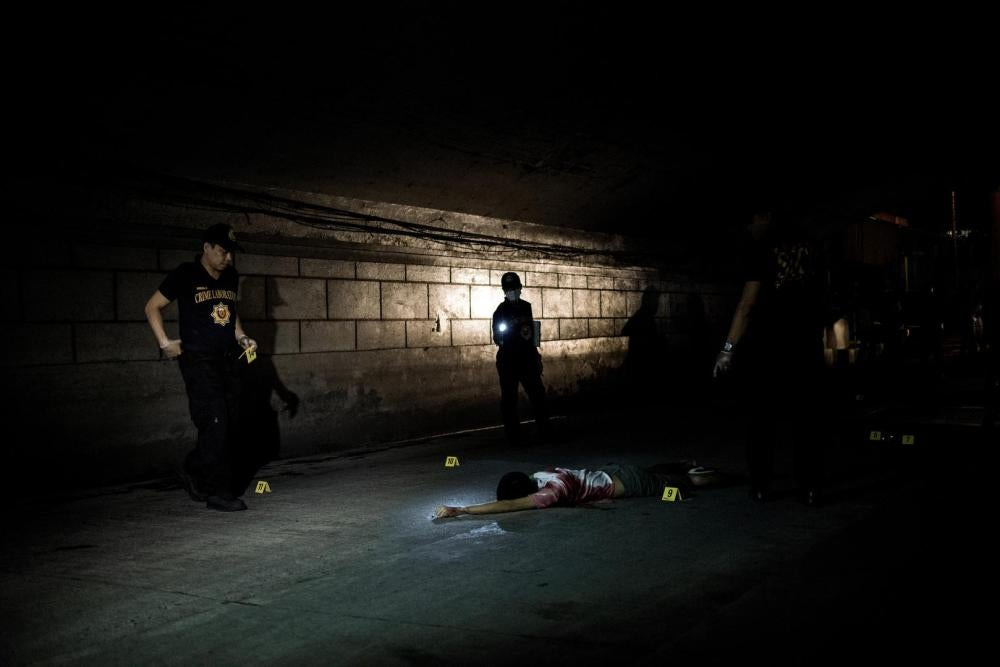
For years since 2016, when Rodrigo Duterte assumed the presidency of the Philippines, they reveled in their impunity as they carried out a brutal and systematic slaughter designed to eliminate a population Duterte had thoroughly demonized. They seemed untouchable, shielded by Duterte’s protection and emboldened by a public that accepted the dangerous lie that safety requires extrajudicial violence.
That era of impunity may have ended on Saturday.
The International Criminal Court’s Pre-Trial Chamber I released a “lesser redacted” version of its charge sheet against the former president for crimes against humanity, and it didn’t stop with Duterte.
Eight individuals were named as “co-perpetrators”: Rogelio “Bato” dela Rosa, Christopher Lawrence “Bong” Go, Vitaliano Aguirre II, Vicente Danao, Camilo Cascolan, Oscar Albayalde, Dante Gierran, and Isidro Lapena. These officials stand accused alongside Duterte, the “main suspect,” in a campaign that human rights groups estimate killed as many as 30,000 people over six years.
The chamber also said “other members of the PNP (Philippine National Police) and high-ranking government officials” were co-perpetrators, making it likely that more will be identified soon.
While arrests remain unlikely in the immediate term, make no mistake: this is a watershed moment for justice in the Philippines. It fundamentally alters the calculus for law enforcement because officers can no longer hide behind the excuse that they were simply following orders.
By naming senior officials who allegedly orchestrated the murderous campaign, the ICC is directly dismantling the Philippines’ entrenched culture of impunity and establishing a new standard for police conduct.
A “National Network” of State-Sponsored Murder
One of the most damning elements of the ICC filing is its description of what prosecutors call a “national network,” essentially the Davao Death Squad scaled to a nationwide operation after Duterte’s presidential victory in 2016.
According to the ICC, police officers weren’t merely permitted to kill suspects — they were incentivized to do so through cash rewards and promotions. Payments for eliminating alleged “high-value targets” ranged from 50,000 pesos to one million pesos. The ICC also documented evidence that police routinely planted firearms, ammunition, and drugs on victims to fabricate justifications for killings, directly contradicting the official narrative that suspects died resisting arrest (“nanlaban”).
By implicating these officials, the ICC is saying that leaders cannot evade accountability by claiming they merely followed orders. When atrocities constitute government policy, everyone in the chain of command bears responsibility.
Why This Matters
For years, officers operated under the assumption they were invulnerable as long as they served a government-sanctioned campaign. Indeed, these officers took comfort in Duterte’s repeated assurance that he would protect them. The ICC case shatters that assumption.
Naming co-cperpetrators delivers an unequivocal message: blind loyalty to superiors offers no sanctuary from justice. For Philippine police and government officials, this is an unmistakable warning that executing unlawful orders carries real, inescapable consequences.
The combined pressure from the ICC, an increasingly assertive Philippine courts, and an empowered human rights community has the power to transform law enforcement culture, from one that normalized violence to one that honors the Constitution and upholds the rule of law.
The question is no longer whether accountability will come. It’s whether those in uniform will recognize it before it’s too late.
In any case, the administration of President Ferdinand Marcos Jr. has a real opportunity here to take to heart the ICC’s actions against these former law enforcers and start instituting needed law enforcement reforms. (Rights Report Philippines)
CORRECTION: An earlier version of this story used “co-conspirators” instead of “co-perpetrators.”