


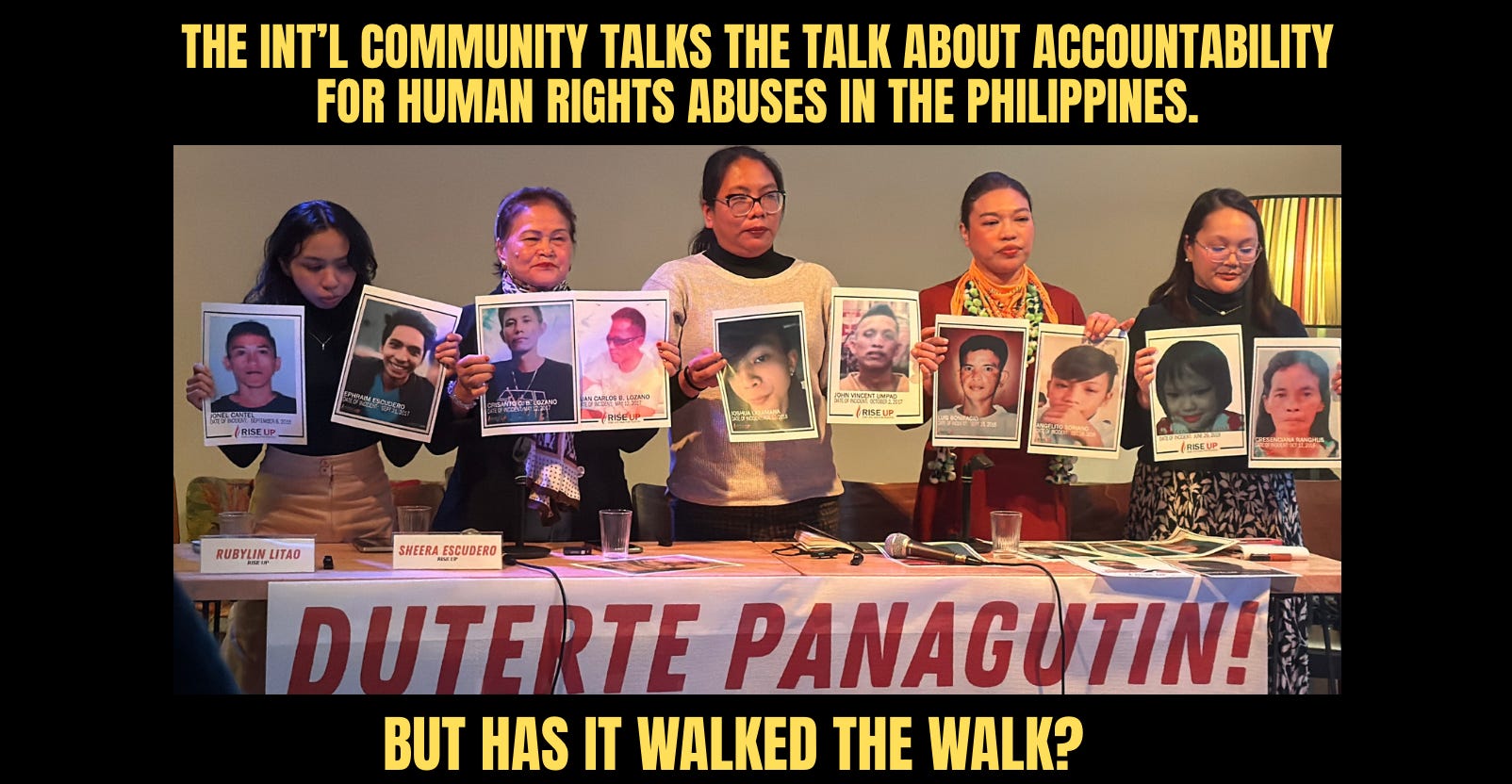
When Rodrigo Duterte stood before the Filipino people and promised to kill tens of thousands of people who use drugs — and then proceeded to do exactly that — the international community had every tool it needed to respond. The United Nations had its human rights mechanisms. The European Union had its prized Generalized Scheme of Preferences Plus (GSP+), a trade incentive program explicitly conditioned on the ratification and implementation of 27 international conventions on human rights, labor, and the environment. The diplomatic missions clustered in Makati had their demarches, their quiet conversations, their carefully worded statements of concern.
None of it mattered.
More than six thousand people killed in official police operations — a conservative estimate — later, accountability remains a distant, largely theoretical prospect. Duterte has since been arrested and transferred to the International Criminal Court but that solitary development should not be mistaken for systemic success. It is, rather, the exception that exposes the rule: that for years, the institutions most loudly committed to human rights watched one of the most brazen extrajudicial killing campaigns in the world unfold in real time – and blinked.
To be fair, these governments were not entirely passive. The EU suspended free trade agreement negotiations with Manila in 2017, citing human rights concerns — a diplomatic signal, true, but a decidedly muted one. The United Nations, for its part, helped establish a Joint Programme on Human Rights in the Philippines, a capacity-building initiative designed to strengthen domestic institutions, improve accountability mechanisms, and support the government’s own human rights commitments. Many rich nations, primarily from the EU, pitched in with their own funds, as did the US, through USAID, and a couple of Asian countries. Other countries like Australia and Canada also had their own program to improve the capacity of rights defenders and civil society.
These were not nothing. They reflected genuine engagement by these countries and international agencies that understood the stakes and worked within the constraints of sovereignty and geopolitics.
But good-faith engagement is not the same as consequence. Nowhere is that gap more glaring than in Brussels. The EU’s GSP+ program — which grants the Philippines preferential tariff access worth hundreds of millions of euros annually — remained intact throughout the worst years of the “drug war” killings. The EU did eventually launch a formal monitoring process and issue pointed statements and reports but it stopped short of doing the one thing that would have mattered: suspend the GSP+. That reluctance to weaponize its most powerful economic lever, even at the height of documented mass killings, revealed the limits of conditionality as a human rights tool when political will is absent.
In this short clip, Cristina Palabay, the secretary-general of Karapatan who has been engaged with these institutions as the “drug war” raged, answered questions about this from Rights Report Philippines’ Carlos Conde.