


The Duterte ICC Hearing — Why This Week Changes Everything
What Is Happening
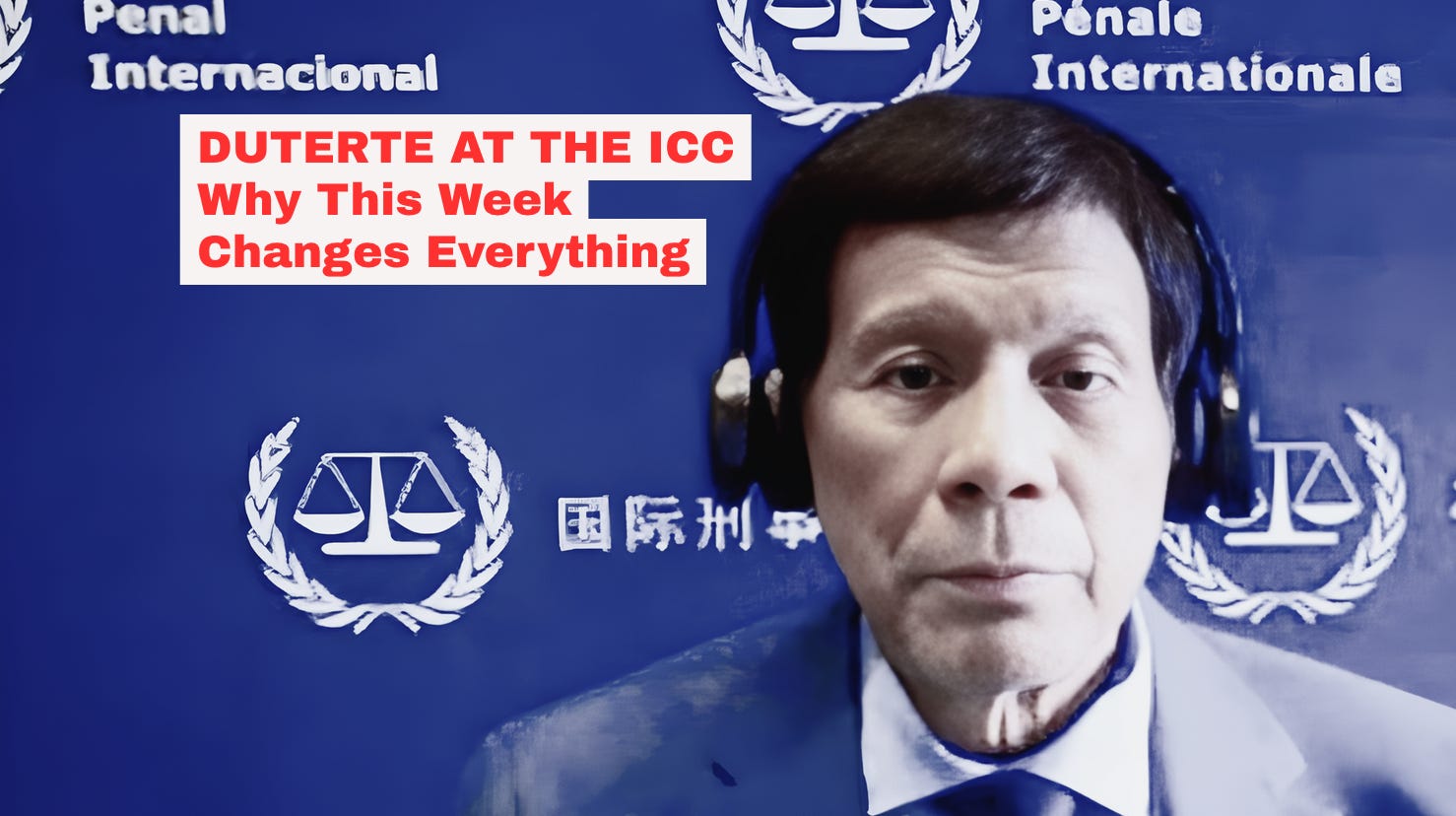
The confirmation of charges hearing in The Prosecutor v. Rodrigo Roa Duterte is scheduled to open on February 23, 2026 at 10:00 a.m. The Hague time, before Pre-Trial Chamber I, with sessions continuing on February 24, 26, and 27. At the hearing, in the presence of the suspect and his defense lawyers, the Prosecution is required to support each of the charges with sufficient evidence to establish substantial grounds to believe that Duterte committed the crimes with which he is charged. Following the hearing, the judges will have 60 days to issue a written decision. The hearing is not a trial and is not aimed at establishing Duterte’s guilt or innocence.
Duterte is suspected of crimes against humanity of murder and attempted murder, allegedly committed between November 1, 2011 and March 16, 2019, covering three counts: murders in or around Davao City by the Davao Death Squad during his mayoral period; murders of high-value targets during his presidential period; and murders and attempted murders in barangay clearance operations.
The Bombshell: Co-Perpetrators Named
The week’s biggest pre-hearing development came on February 13, when the ICC prosecutor published a lesser-redacted version of its charging document, revealing for the first time the names of eight alleged co-perpetrators. Senators Ronald “Bato” dela Rosa and Christopher “Bong” Go are among the co-perpetrators named, alongside former police chiefs Oscar Albayalde, Vicente Danao, and the late Camilo Cascolan; former National Bureau of Investigator director Dante Gierran; former Philippien Drug Enforcement Agency chief Isidro Lapeña; and former Justice Secretary Vitaliano Aguirre II.
Prosecutors allege that Duterte and his co-perpetrators operated under a “common plan” to “neutralize” alleged criminals, including those perceived to be involved in drug-related activities, through violent crimes including murder. The plan allegedly originated in Davao City and was later expanded nationwide once Duterte assumed the presidency in 2016.
According to the filing, the alleged killings were first carried out in Davao by police officers and hired gunmen under the so-called Davao Death Squad, which prosecutors said operated under a “hierarchical structure with Duterte at the top.” The handlers reported to co-perpetrators including dela Rosa, Danao, and Go, who in turn reported to Duterte. “Duterte’s approval was required for DDS members to conduct killings in Davao City,” the document stated.
Among the specific named victims is 17-year-old Kian Loyd delos Santos, killed in August 2017 during barangay clearance operations. Prosecutors also allege a covert reward system for killings, with payments ranging from ₱50,000 to ₱1 million.
Dela Rosa has not been seen in public and has not been reporting to work in the Senate since rumors of a possible ICC warrant against him began circulating. Go denied the allegations, saying the document was “unfounded and unfair.” Human rights organizations, including the International Coalition for Human Rights in the Philippines (ICHRP), are pushing for the ICC to urgently issue arrest warrants for the co-perpetrators, saying “it remains abundantly clear that the Philippine judicial system is unable to prosecute these alleged co-perpetrators.”
Victim Participation: A Historic Dimension
The ICC authorized 500 new applicants to participate as victims in the case, bringing the total number of participating victims to over 539. The judges admitted the applicants after determining they “clearly qualify as victims” in relation to the charges outlined by the Office of the Prosecutor.
Victims can attend the confirmation of charges hearing if they wish and if the security situation allows, though the ICC cannot cover travel costs. Victims participate through their appointed Common Legal Representatives — in this case, lawyers Joel Butuyan and Gilbert Andres of CenterLaw — who speak and act on their behalf before the judges.
The human cost behind these legal proceedings is staggering. Police in the Philippines reported that about 6,200 Filipinos died during government anti-drug operations between 2016 and 2022. Human rights groups contend that as many as 30,000 people were killed in the “war on drugs,” most of them impoverished people in urban areas. Many children were among those killed.
Victims Speak Before the Hearing Opens
In a press conference on February 17, families of drug war victims described what they have endured — and what the hearing means to them. Bernadette Escudero, whose son Ephraim disappeared on September 19, 2017, and was found days later in a province more than 100 kilometers from home with his head covered in packaging tape and his arms and feet tied, said: “For us victims, the confirmation of charges against Duterte is an answered prayer. It is clear to us that the ICC shows the call for justice does not end in the Philippines. Politicians who violate the law can also be held accountable under international law.”
Families also reported that coordinated troll attacks have intensified ahead of the hearing, flooding the social media posts of human rights groups with content mocking and distorting the testimonies of victims. The Duterte Panagutin Campaign Network called this “exactly what the families of drug war victims have faced for years: a machinery of fake news, harassment, and organized online attacks meant to discredit them and protect those responsible.”
Karapatan Secretary-General Cristina Palabay noted: “The road for justice and accountability has been long, tedious, and dangerous.”
📌 WHY THIS MATTERS: Analysis
1. The ICC as the court of last resort. Domestic accountability for drug war killings has been virtually nonexistent. Philippine courts have convicted only a handful of police officers for isolated killings — none of the senior officials who oversaw the campaign have faced prosecution at home. The ICC stepped in precisely because of this failure of the Philippine justice system, and the confirmation of charges hearing is the first time a sitting or former head of state from Southeast Asia faces this level of international judicial scrutiny.
2. The “common plan” theory reshapes accountability. The naming of co-perpetrators is not a peripheral development — it is central to the prosecution’s theory of the case. As ICC-accredited lawyer Ross Tugade noted, the inclusion of the names of former Duterte officials indicates “that the ICC has evidence” to show a “criminal structure” in the commission of the alleged crimes. Establishing that killings were not rogue acts but the product of a coordinated command structure — from Duterte at the top down through police chiefs, regional directors, and hired gunmen — is what elevates the charges to crimes against humanity rather than ordinary criminal acts.
3. The drug war continues under Marcos. President Marcos has never repudiated the “war on drugs” as a state policy and has not rescinded Duterte’s orders and other policy statements. Independent monitoring by the Dahas Project of the University of the Philippines shows more than 1,000 drug-related killings since Marcos took office in July 2022. The ICC proceedings are therefore not merely historical — they speak directly to a pattern of impunity that persists today. HRW has called on Marcos to publicly declare an end to the drug war, order credible investigations, and take steps to rejoin the ICC.
4. Global rule of law at stake. Ongoing US sanctions against the ICC and in absentia criminal convictions of ICC officials in Russia are indicative of growing attacks on the global rule of law. Progress in the Duterte case affirms the court’s relevance and significance in ensuring accountability for grave international crimes. For the ICC, a court that has faced persistent criticism for focusing primarily on African cases, the Duterte proceedings represent a significant test of universality and institutional credibility.
5. What happens next. If Pre-Trial Chamber I confirms all or some charges, the case proceeds to a full trial before a separate Trial Chamber. Judges have 60 days after the conclusion of the hearing to issue their written decision. Should the case go to trial, it would be the most consequential human rights trial in Philippine history — and one of the most watched ICC trials ever.
Sources:
HRW Q&A on the confirmation of charges hearing: https://www.hrw.org/news/2026/02/16/philippines-icc-hearing-to-confirm-duterte-charges
HRW news release: https://www.hrw.org/news/2026/02/16/philippines-duterte-icc-hearing-set-to-begin
ICC official case page: https://www.icc-cpi.int/philippines/duterte
ICC practical information on the hearing: https://www.icc-cpi.int/news/duterte-case-confirmation-charges-hearing-open-23-february-2026-practical-information
ICC victim participation page: https://www.icc-cpi.int/victims/duterte-case
Rappler — Co-perpetrators named: https://www.rappler.com/philippines/icc-additional-co-perpetrators-duterte-february-2026/
Philippine Star — Co-perpetrators named: https://www.philstar.com/headlines/2026/02/14/2507952/icc-names-bato-bong-go-dutertes-alleged-co-perpetrators-charges
Philippine Star — Arrest warrants pushed: https://www.philstar.com/headlines/2026/02/16/2508323/icc-arrest-orders-vs-duterte-co-perpetrators-pushed
Philippine Daily Inquirer: https://globalnation.inquirer.net/309081/bato-dela-rosa-bong-go-icc-duterte-drug-war
Manila Times — Charging document: https://www.manilatimes.net/2026/02/14/news/icc-names-dela-rosa-go-as-co-perpetrators-in-new-duterte-charge-sheet/2278345
Al Jazeera: https://www.aljazeera.com/news/2026/2/14/two-philippine-senators-named-co-perpetrators-in-duterte-icc-case
Bulatlat — Victims speak ahead of hearing: https://www.bulatlat.com/2026/02/18/kin-of-drug-war-victims-ready-for-duterte-icc-hearing/
Manila Bulletin — Victim participation: https://mb.com.ph/2026/01/28/drug-war-victims-to-take-part-in-duterte-icc-hearing-from-feb-2327
Journalist Frenchie Mae Cumpio — Bail Denied After Six Years
The case of community journalist Frenchie Mae Cumpio continues to draw global condemnation. More than 90 media organizations have called her conviction — on terrorism financing charges — unjust, and her bail denial this week leaves her facing 12–18 years in prison after already spending over six years in pre-trial detention. International press freedom groups have nominated her for the 2026 UNESCO Guillermo Cano World Press Freedom Prize. Her case is widely seen as a textbook illustration of how red-tagging and anti-terror laws are used to suppress community journalism in the Philippines.
Sources:
CPJ — Bail denied: https://cpj.org/2026/02/philippine-journalist-frenchie-mae-cumpio-denied-bail-to-remain-in-prison-after-6-years/
CPJ — UNESCO nomination: https://cpj.org/2026/02/cpj-nominates-philippine-journalist-frenchie-mae-cumpio-for-unescos-guillermo-cano-prize/
Bulatlat — UNESCO nomination: https://www.bulatlat.com/2026/02/14/intl-groups-nominate-frenchie-mae-cumpio-for-unescos-2026-guillermo-cano-prize/
Red-Tagging, Killings and Ongoing Impunity
HRW’s World Report 2026 documents the persistence of extrajudicial killings, enforced disappearances, and harassment of activists under the Marcos administration, with security forces rarely held accountable. Three journalists were killed in 2025. Red-tagging continues despite a 2024 Supreme Court ruling declaring it a threat to life, liberty, and security. Karapatan documents 134 extrajudicial killings, 822 arbitrary arrests, and 14 enforced disappearances under the current administration.
Sources:
HRW World Report 2026 — Philippines: https://www.hrw.org/world-report/2026/country-chapters/philippines
HRW news release: https://www.hrw.org/news/2026/02/04/philippines-harassment-killings-of-critics-persist
Karapatan: https://www.karapatan.org
This briefing was generated with AI assistance but edited and verified by Rights Report Philippines. If you spot any error – whether factual or contextual – let us know.