


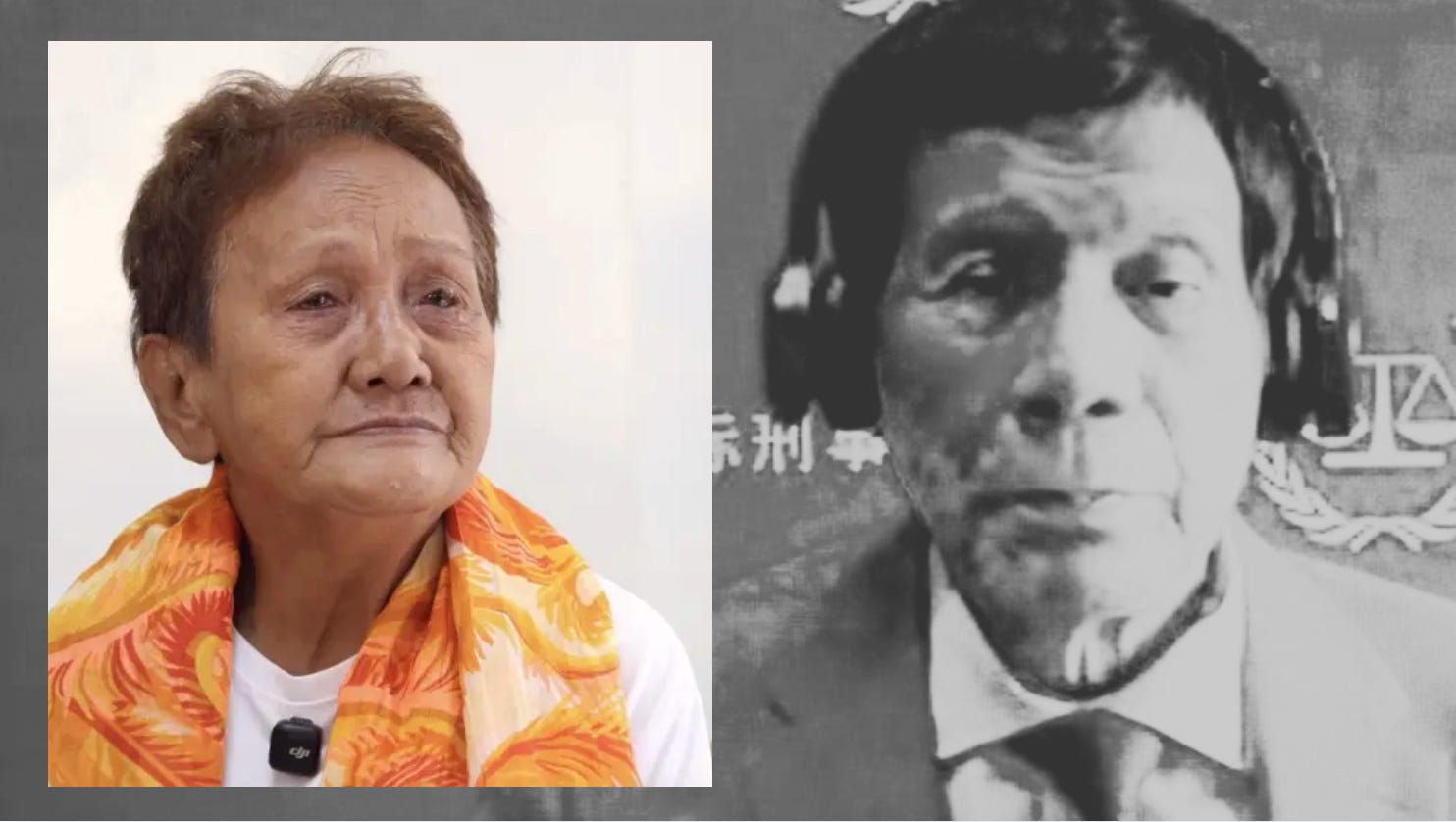
The International Criminal Court’s Pre-Trial Chamber I recently disclosed that an additional 500 victims of former president Rodrigo Duterte’s “drug war” have been included in its lists of participants at the confirmation of charges hearing scheduled in The Hague later this month. This brings to 539 the number of victims or the representatives from their families who are directly involved in the investigation of the extrajudicial killings attributed to the former president. Although Clarita Alia, the Davao City mother who lost four of her sons to Duterte’s Davao Death Squad, is not among those included — the killings of her four sons between 2001 and 2007 occurred before the Philippines ratified the Rome Statute that created the ICC — the relevance of her plight in the search for accountability is immeasurable.
Nanay Clarita became the “poster mother” of the impunity in Duterte’s violent anti-crime campaign in Davao City, where he was mayor for years. (Carlos Conde first wrote about her case back in 2001 for the Philippine Center for Investigative Journalism.) The violence in that city propelled Duterte to extreme popularity, which he exploited when he ran for president in 2016,. After winning the election, he used the exact same Davao Death Squad template for his nationwide “drug war” that killed tens of thousands.
We are republishing these two opeds Conde wrote for The Washington Post (2021) and The Hill (2025).
Duterte Is Worried About the ICC. He Should Be.
By Carlos H. Conde
First published in The Washington Post
Clarita Alia remains anguished, nearly 20 years after I first heard her express her grief.
“His name was Danilo Lugay,” she told me over the phone recently from Davao City, in the southern Philippines. Police killed Lugay in September 2020 during a drug raid; a news report of the killing said he had fought back and police officers shot him. Lugay, 28, was the grandchild of Alia’s sister Naneth.
Alia’s voice cracked as she described what happened — the same pained voice that I heard when I interviewed her in 2002 for a report on the killing of her sons Richard, Christopher and Bobby, all teenagers. Assailants later murdered a fourth son, Fernando, in 2007. This unimaginable family tragedy gave Alia, a vegetable vendor who lives in a slum community, the label of poster mother for the city’s bloody “war on drugs,” in which police use extrajudicial executions instead of prosecutions as a primary method of punishing criminal suspects.
At the center of all this violence is Rodrigo Duterte, the longtime mayor of Davao City who parlayed his tough-guy image into a potent political force that got him elected president in 2016. Many Filipinos love, adore and make excuses for his steady stream of crude, unrestrained remarks using the pretext of law and order to sell his “drug war.” They believe that he is the leader who — after decades of political dysfunction, corruption, insurgency and growing crime — can turn the Philippines into “another Singapore.”
The cost of Duterte’s anti-drug campaign has been high. Since 2016, police and their agents have killed at least 6,000 people — but likely closer to 30,000 — across the country. Human Rights Watch and others, including United Nations High Commissioner for Human Rights Michelle Bachelet, have expressed alarm about the government’s systematic campaign of violence and disregard for due process, in which, according to reports, police routinely plant guns and drugs on bodies to justify their claim that suspects “fought back.”
Rampant impunity has long protected Duterte and other officials from prosecution in the Philippines for serious rights abuses. But Duterte appears to have feared the reach of international justice. Soon after the February 2018 announcement by then-International Criminal Court prosecutor Fatou Bensouda that her office was closely examining allegations of crimes against humanity during the president’s “drug war,” Duterte ordered the country’s withdrawal from the ICC.
Killings committed since Nov. 1, 2011, when the Philippines joined the ICC, are within the ICC’s jurisdiction, including those in Davao City. Duterte’s efforts to evade ICC prosecution shields him and other officials only from killings after March 2019, when the withdrawal took effect. But Alia’s sons were killed in 2001, 2002 and 2007, while Duterte was mayor. Lugay was killed in September 2020. All are outside the ICC’s jurisdiction.
“Why can’t our cases be investigated?” a distraught Alia said on the phone. “What will happen to us?”
It’s a question that thousands of Filipino families ask each day, as Duterte’s “war on drugs” rages. The current anti-drug campaign nationally has many similarities with Duterte’s brutal campaign in Davao City, where petty criminals, including street children, were shot or knifed to death, as in the case of the Alia teenagers. The killings, which other cities have also copied, continued during Duterte’s last term as mayor there, from 2013 to 2016.
But even with the limits on ICC prosecutions, there is now some hope that those responsible for the thousands of drug war killings may face consequences. On Sept. 15, the ICC formally opened an investigation into allegations that Duterte committed crimes against humanity. This is among the most hopeful news for human rights in the Philippines since the fall of the dictator Ferdinand Marcos in 1986.
Duterte, who announced his retirement from politics this weekend, is evidently rattled. He has lashed out at international bodies such as the U.N. Human Rights Council, and barred U.N. human rights experts from entering the country. He and his spokespersons insist that the ICC does not have jurisdiction in the Philippines because, among other claims, the country’s signing of the ICC treaty in 2011 was not published in the official gazette — a preposterous and irrelevant claim that is undermined by Manila’s own act of withdrawal from the statute.
“When can I ever get justice?” Alia asked me on the phone. For a mother who has lost so much, there’s probably no answer that could ease her pain. An ICC investigation at least provides hope that a measure of justice will be done. And in the Philippines, that’s a big deal. *
I Covered Duterte’s Rise. His Victims’ Families Feared He Was Untouchable.
By Carlos H. Conde
First published in:The Hill
Calls with Clarita Alia always have moments of sheer pathos. “Will his arrest bring back my sons? Of course not!” she said over the phone, through tears.
But they were tears of joy, because Philippine authorities had arrested former President Rodrigo Duterte in Manila on March 11 and flown him to the International Criminal Court in The Hague. Days earlier, the court’s judges had issued an arrest warrant against Duterte for his responsibility in the crime against humanity of murder, allegedly committed between 2011 and 2019.
Alia, 71, is from Davao City in the southern Philippines, where Duterte, as mayor, developed the template for what became his bloody “war on drugs” after he became president. I first interviewed her in 2002, when I wrote one of the first major reports on the rise of the “Davao Death Squad,” a band of assassins Duterte allegedly formed and financed to target suspected criminals.
Alia had already lost three of her seven children to the death squad when we spoke. Richard, 18, had been killed in July 2001; Christopher, 16, in October 2001; and Bobby, 14, in November 2002. A fourth son, Fernando, 15, was killed subsequently in April 2007.
Her boys were among the hundreds of poor Filipinos suspected of some petty crime or another — often just illegal drug use — to be slaughtered on Davao’s streets. The killings were brazen. Alia’s sons were all stabbed to death, one of them with a butcher’s knife.
I covered these extrajudicial killings for years as a journalist. Mothers kept losing their sons. Women and children kept losing their husbands and fathers. Friends kept losing friends in a frenzy of violence that the city’s residents and the Philippine public largely ignored.
In 2009, bolstered by a report from Human Rights Watch, the governmental Commission on Human Rights opened an investigation into the Davao killings. The commission ended its inquiry in 2012 by asking the Office of the Ombudsman to look into possible liability of Davao officials. But no one was ever prosecuted.
In 2016, Duterte rose to the presidency of the Philippines on the promise to eradicate crime and drugs using the same methods he had honed in Davao. This time, the killings took a more organized, more systematic turn, with the involvement of the Philippine police, as reports we and others issued showed. The targeted group remained the same — mostly impoverished Filipinos — but the death toll was in the thousands.
Duterte also went after his critics, chief among them Leila de Lima, the former chair of the rights commission that investigated the death squad. She had since become a senator, but he had her arrested and detained for nearly seven years. Other critics were targeted with harassment and lawsuits, such as the journalist Maria Ressa, who later won a Nobel Peace Prize for her efforts.
Even as the inquiry began into Duterte’s anti-drug campaign, many Filipinos across the country and overseas tolerated and even celebrated the killings. This popular support for the “drug war” is one of the reasons relatives of victims pinned their hopes on the International Criminal Court.
“We couldn’t rely on local courts — the justice system in the Philippines was not working,” Randy delos Santos told me this week. He was the uncle of Kian delos Santos, 17, whom police shot dead in 2017.
Until Duterte’s arrest, many families felt that the quest for justice had become fruitless. Now that he has appeared before a court of law, their hope for some measure of justice has been revived. “They know it [a conviction] is a longshot, but they’re happy that the process has begun,” a volunteer from one of the Philippine groups helping victims told me.
The case against Duterte in The Hague is a stark reminder of the importance of the International Criminal Court as a court of last resort, standing for equality before the law, with the potential to reach even those thought to be untouchable.
But it is precisely because the court is pursuing its global mandate that it is currently under attack. In February, President Donald Trump issued an executive order authorizing sanctions against its officials and others supporting the court’s work, in a bid to shield U.S. and Israeli officials from facing charges of war crimes and crimes against humanity.
The court can overcome these challenges, but only with the support of the international community and its member countries. This is true when it comes to confronting the sanctions and to securing more arrests across the court’s docket. International Criminal Court member countries should step up their efforts to protect the court that they created to ensure that the victims of the most serious crimes have access to justice.
Clarita Alia’s sons were killed before the Philippines joined the International Criminal Court, and so their deaths are not among those being investigated. “No case was ever filed in court, their killers remain free,” Alia told me between sobs. But with Duterte’s arrest, “I’m happy just the same.” *