


By Carlos H. Conde
Rights Report Philippines
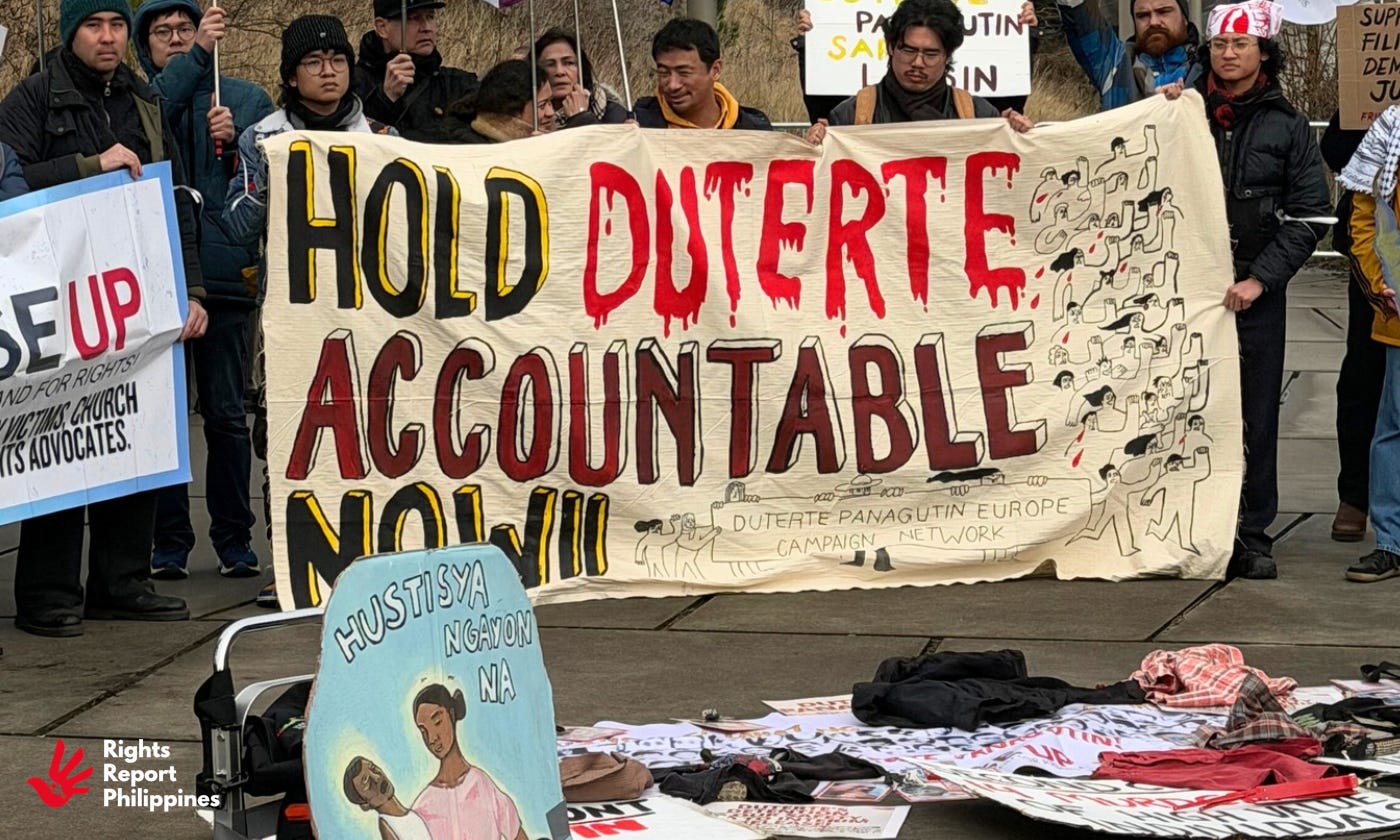
I HAD the privilege of seeing what has been called a turning point for justice and accountability in the Philippines last week in The Hague. Rodrigo Duterte was physically absent from the Pre-Trial Chamber I of the International Criminal Court during the confirmation of charges hearings, but he was definitely there. Duterte gained power not only through incendiary bluster but also by launching a “drug war” that killed thousands of people and caused the nation’s worst human rights crisis since World War II. So his absence didn’t matter as much to those who were there—the victims’ families and their supporters—as what the event symbolized: that justice, albeit a slow-moving one, is finally within reach.
For years, Duterte dared the world. He cursed the ICC and the international community, withdrew the Philippines from the Rome Statute, and boasted openly about the killings carried out under his “war on drugs.” He governed as though impunity were his birthright. History and the law are now proving him wrong.
Duterte was arrested in Manila in March last year, flown to the Netherlands, and placed in the ICC’s detention unit at Scheveningen Prison in The Hague—the same facility that once held war criminals Slobodan Milosevic and Charles Taylor. The ICC confirmation of charges hearing concluded last week, with judges now deliberating on whether to send the case to full trial. The arguments for why that trial will happen—and why it should—are overwhelming. But so is the argument that a trial or conviction alone will not be enough to end impunity in the Philippines.
Duterte’s most persistent legal defense has been the claim that the ICC has no authority over him. It is a hollow argument that serves mainly to rouse his diehard supporters. Questioning jurisdiction is also in the playbook by international lawyers such as Nicholas Kaufman—the aim is to kill the case before it even gets traction.
The Philippines was a party to the Rome Statute from November 1, 2011, up until its withdrawal took effect on March 17, 2019. The ICC, therefore, has jurisdiction over crimes committed during that period. This is not a novel legal interpretation—it is the plain text of Article 127 of the Rome Statute, which expressly preserves the court’s jurisdiction over crimes committed before a withdrawal takes effect.
The defense has appealed the jurisdiction ruling, but the court has firmly held that it retains authority over covered crimes committed from 2011 to 2019. Multiple ICC chambers have consistently upheld this framework. Duterte’s team is fighting a legal battle on terrain that has already been decisively lost.
Duterte faces three counts of crimes against humanity: murders and attempted murders allegedly carried out within the covered period, spanning his time as mayor of Davao City and as president of the Philippines. ICC prosecutors have charged Duterte with crimes against humanity for at least 76 murder cases from 2013 to 2018, while the true number of killings during his campaign is thought to be as high as 30,000.
The evidentiary record is not thin. The ICC’s Office of the Prosecutor has disclosed thousands of items of evidence to the defense, including witness statements, documentary material, audio-visual material, and forensic and contextual evidence. That volume of disclosure reflects years of serious investigative work, not a political witch hunt.
The legal theory underpinning the charges is also well-established in ICC jurisprudence. ICC judges have found reasonable grounds to believe that Duterte is individually responsible as an indirect co-perpetrator for the crime against humanity of murder. The concept of “indirect co-perpetration”—whereby a commander who dominates an organizational apparatus is held responsible for crimes carried out through it—was developed and affirmed in previous ICC cases. Crucially, the ICC’s own Pre-Trial Chamber has noted that domestic proceedings in the Philippines “only address the physical, low-ranking perpetrators and at present do not extend to any high-ranking officials.” This finding is damning: the Philippine justice system, left to its own devices, has been protecting those at the top of the chain of command.
The defense made an audacious bid to halt proceedings entirely, claiming Duterte was mentally unfit. Following a request for an indefinite adjournment, the chamber appointed a panel of three independent medical experts in forensic psychiatry, neuropsychology, and geriatric and behavioral neurology. On January 26, 2026, the chamber found Duterte fit to take part in the pre-trial proceedings. The court’s process was rigorous and conclusive. The clock could not be stopped.
Nobody is above the law. That principle is not rhetorical—it is the founding premise of the Rome Statute, which is the treaty that established the ICC and outlines its functions and jurisdiction. Duterte is the first Asian former head of state to appear before the ICC, a historic milestone that signals the court’s reach is not limited to Africa or the Balkans, as Duterte and his supporters have always claimed.
But let us be clear about what an ICC conviction can and cannot do. The trial of Rodrigo Duterte, no matter how just or necessary, will not dismantle the structures that made his “war on drugs” possible. The ICC trial is limited by its focus on individual guilt and juridical process. The ICC cannot rebuild the communities devastated by decades of neglect and violence. It cannot reweave the frayed social contract between the state and its people and between and among Filipinos who found themselves at opposing ends of a fiery and alienating national discourse.
Apart from the arrest of Duterte, there’s almost zero accountability for those responsible for these deaths, mainly law enforcement agencies and others involved in the violence. And although drug war violence has decreased, incidents are still being reported. The drug war as a policy stands under the Marcos administration.
This void is the gap that must be filled—and it can only be filled at home.
Prioritizing comprehensive law enforcement reforms is a baseline, not a ceiling. What is required is a wholesale reckoning: an honest-to-goodness overhaul of law enforcement culture, where the use of drug watch lists and vigilante-style operations is replaced by due process and proportionate policing.
The country’s drug policy requires comprehensive reform. Harm reduction needs to be institutionalized. The Philippine government needs to end its punitive approach to drugs entirely and to provide adequate health and harm reduction services for people who use drugs that are evidence-based and respectful of the rights and dignity of all people. Criminalization-first approaches have been proven, repeatedly and globally, to fail the poor while leaving the narcotics trade intact.
Evidence-based treatment, decriminalization of drug use, and investment in communities gutted by poverty—these are not soft alternatives to accountability. They are its necessary complement.
The criminal justice system, too, demands serious reform. Domestic accountability mechanisms have failed. Prosecutors, judges, and investigators must be genuinely insulated from political interference. Witness protection must be real and robust—people are afraid, supporters of the proceedings are branded as enemies of the state, and some are even forcibly disappeared.
The international community needs to step up as well. The UN Human Rights Council, the European Union, and foreign governments must enhance their efforts to ensure that all available mechanisms are fully utilized rather than merely serving as public-relations opportunities for embassies and diplomats. Human rights need to be at the center of foreign trade agreements or ongoing negotiations for them, especially given how ineffective, for instance, the EU’s GSP+ program has been at making a dent against the “drug war” violence while it was happening.
Civil society, for its part, must be allowed to do its work without fear. The organizations that documented the killings, supported the families, and carried the evidence to The Hague did so at personal risk. They deserve protection, not persecution.
The trial of Rodrigo Duterte will happen. Indeed, it is a watershed moment for accountability in the Philippines and in Asia and a vindication of international justice. But without real reforms of the police, the drug laws, the courts, and the political culture that shielded mass killing for years, impunity in the Philippines will simply wear a different face.
At the ICC last week, as some families of victims of the “drug war” made the difficult effort to recount to anyone who would listen how the “drug war” upended their lives, it became even clearer to me and many of those present that the thousands and thousands who died in the violence deserve more than a verdict in The Hague. They deserve a country that will never allow this to happen again. (Rights Report Philippines)
Carlos Conde is the editor of Rights Report Philippines. Before that, he was the Philippines researcher for Human Rights Watch and the freelance correspondent in Manila for The New York Times. Since the late 1990s, he has reported extensively on the human rights violations linked to Rodrigo Duterte while he was mayor of Davao City and later as the president of the Philippines.
—
This story is free for republication or reposting as long as proper attribution or credit is given to Rights Report Philippines.